


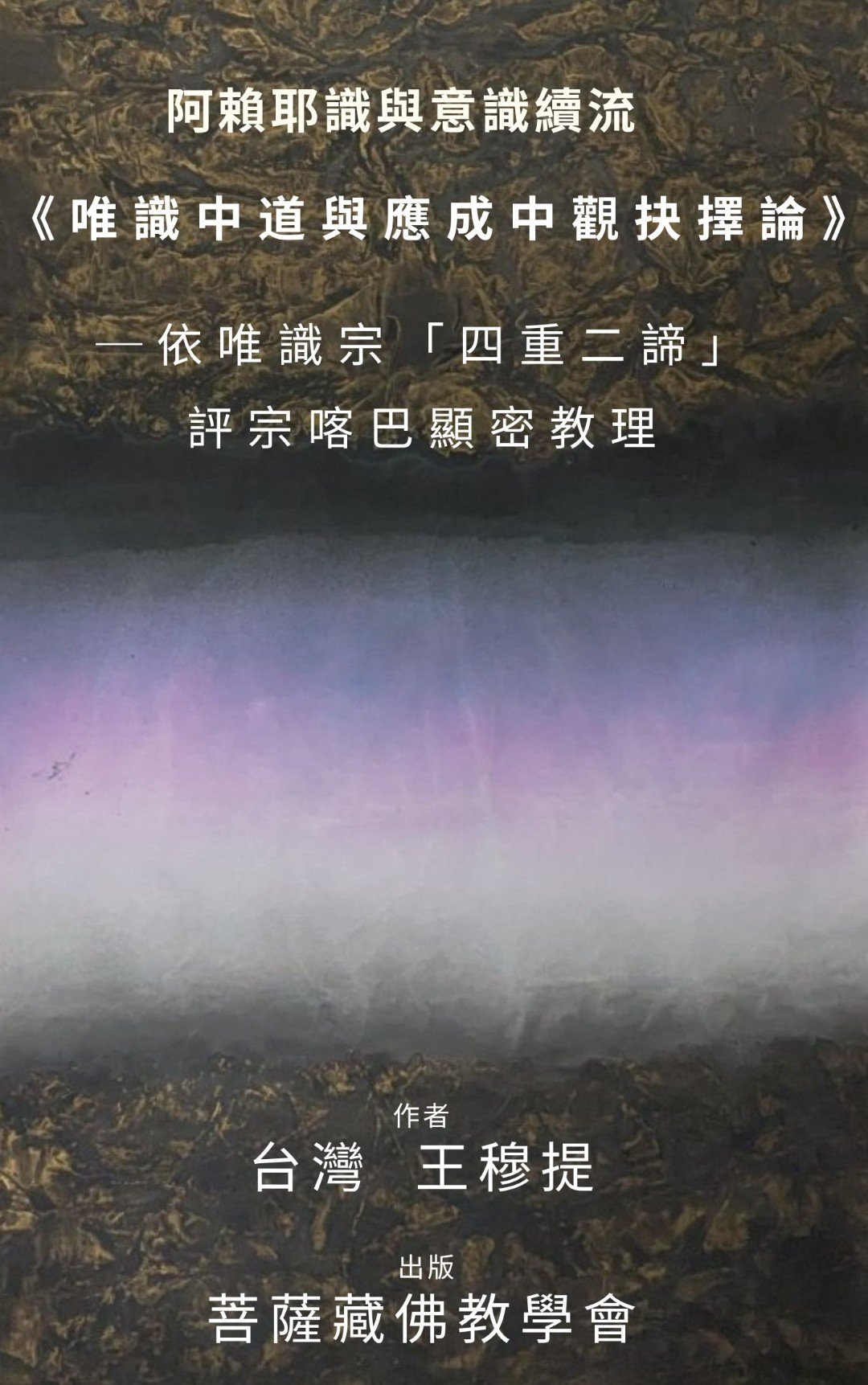
在西藏佛教史中,格魯派祖師宗喀巴大師於末法季世崛起。為挽救當時戒律廢弛、教理混濫的流弊,大師宗承月稱論師的「應成派中觀見」,著述《菩提道次第廣論》與《入中論善顯密意疏》等巨作。宗喀巴大師在教理上獨尊中觀應成派,將「緣起性空」奉為最究竟之真理,並嚴格將唯識宗判為「不了義」的方便說,甚至破斥「阿賴耶識」與「自證分」的存在。此一判教,深刻影響了藏傳佛教數百年的教義發展。
然而,若以大唐玄奘三藏與慈恩窺基大師所傳譯之《成唯識論》正宗法相體系來看,宗喀巴大師的諸多破斥與立論,在嚴密的因明邏輯與唯識心法中,實有待商榷之處。本書作者王穆提,本著探究大乘究竟實相的悲智,特以唯識宗的經論為圭臬,對宗喀巴大師所執之中觀見與密法教義,進行了一場跨越時空與地域的深度「抉擇」。造此論之目的,乃是期盼在破迷顯理的過程中,重新確立唯識中道的至高地位,最終達成「漢藏融通,歸於一乘」的圓滿法界。
貳、 判教準則:大唐慈恩宗之「四重二諦」
要評判兩大哲學體系的高下,必須先確立一把精準的測量尺標。本書的判教核心,立基於《瑜伽師地論》與《大乘法苑義林章》中所建立的「四重二諦」體系。唯識宗認為,「真俗二諦」並非僅有簡單的「性空」與「名有」兩層,而是具備由淺入深、由相入性的四個層次:
世間世俗與世間勝義:從凡夫共許的虛妄現象(如瓶衣軍林),進階到聖教安立的基礎法則(如蘊處界)。
道理世俗與道理勝義:從隨事差別的蘊處界,進階到依理推求的四諦之理(苦集滅道)。
證得世俗與證得勝義:從依詮安立的四諦理,進階到聖智親證、離一切相的「二空真如」(空性)。
勝義世俗與勝義勝義:從猶帶空言的二空真如,最終契入言語道斷、非空非不空、具足無量真實功德的「一真法界(唯識實性/圓成實性)」。
作者犀利地指出,宗喀巴大師與格魯派的「應成中觀見」,雖然極力破斥實有,成功帶領行者證入空性,但在唯識學的嚴格判攝下,其境界僅止步於第三重「證得勝義」。宗喀巴大師將「性空無自性」視為終極真理,卻未能建立第四重「勝義勝義」。若連作為染淨依託的「依他起性(識體)」也一併空去,則會墮入「損減執(惡取空)」,破壞了建立因果與佛果無漏功德的深層基石。
參、 核心抉擇:唯識與中觀的五大論議
本書沿著《成唯識論》的脈絡,針對格魯派的教義進行了全面且細緻的破立。其核心的論議可歸納為以下五點:
一、 生命主體與因果載體:阿賴耶識與意識續流
宗喀巴大師為防範外道「神我」思想,破斥實有阿賴耶識,主張依靠「意識之前後續流」或「微細風心」即可持種並連結因果。本書依唯識理嚴正反駁:第六意識在深睡、悶絕或無心定中會發生「間斷」,且意識通於善惡,其性質與功能根本無法承擔「受熏、持種、異熟、執受」的重任。若廢除性唯「無覆無記」的阿賴耶識,生命相續與因果業報將面臨斷滅的邏輯危機。阿賴耶識並非方便說,而是宇宙因果不爽的唯一物理與心理學基石。
二、 認識論的極限:唯識無境與名言外境
格魯派主張勝義中雖無自性,但在「名言世俗」中必須承認心外有客觀外境,否則將破壞世間的共許常識。唯識宗則以玄奘大師的「真唯識量」與三性理論反擊:凡夫眼識所見的山河大地,皆是阿賴耶識變現的「內相分」。若執著心外有獨立實體,即是根本的「法執」與「遍計所執性」。唯識宗以「境無識有」的智慧,徹底將外境攝歸於內心,確立了「似外境現皆是錯亂」的真現量標準。
三、 心理微觀與認知機制:自證分與心王心所
針對格魯派以「刀不自割」為喻破斥心識的「自證分」,本書指出心識的本質是「了別」,如同燈能照物亦能「自照」。若無自證分錄製認知過程,人類的「回憶」功能將無因生起。此外,本書精細剖析唯識的「六大根本煩惱」與「五十一心所」,指出格魯派將一切煩惱唯歸咎於「薩迦耶見(我執)」過於粗略。唯識學強調對治煩惱必須「別別對治」,方能精準淨化識田中的各別染污種子。
四、 成佛的因果與權實:五姓各別與一乘究竟
格魯派依《般若》與《法華》,主張一切眾生皆具「理佛性(空性)」,定當成佛。唯識宗則依《解深密經》的究竟了義指出,成佛不僅需要「理佛性」,更需要阿賴耶識中法爾本有的「無漏種子(行佛性)」。如同土中無金礦則煉不出黃金,若無無漏種子(如無種姓或定性二乘),縱然歷經千劫修習空性,亦無法結出成佛之果。唯識宗堅持「五姓各別」的因果鐵律,展現了法界實相的冷峻與精密。
五、 密法神變的唯識學解構
本書最精彩之處,在於運用唯識學理,為藏傳佛教的無上密續(生起次第、圓滿次第、氣脈明點)提供了前所未有的科學化與哲學化詮釋:
生起次第與壇城:並非格魯派所言僅是意識的「勝解作意(如幻想像)」,而是透過定力引發阿賴耶識四大種子,變現出具備實體功能的「定果色(定自在所生色)」,是真實的物理與心識重構。
氣脈明點與風心:密宗所言的「最細風心」,在唯識學看來,風(氣)即是阿賴耶識所變現的「觸處相分」,心即是「見分」。氣脈的流動,實為阿賴耶識對色身的「執受轉化」。
真言咒語:並非僅是信仰的緣起,而是「名言種子」的物理頻率。透過特定的音頻共振,直接震動阿賴耶識深處的樞紐,達成高頻的程式改寫(轉依)。
肆、 歸趣與願景:唯識中道與漢藏圓融
作者在全書的推演中,清晰地描繪出「唯識中道」的至高無上:「遍計本空,依圓實有;非空非不空,離增減二邊。」
破除格魯派的某些論點,並非為了貶低中觀,而是為了指出過度偏重「遮遣(解構)」容易墮入虛無與斷滅的流弊。中觀的應成邏輯,宛如一把銳利的掃帚,能掃蕩凡夫堅固的遍計所執;然而,修行的最終目的在於「建設」清淨的佛國淨土與四智圓明的佛果。這必須仰賴唯識宗的「阿賴耶識持種」與「轉識成智」的實體工程。
本書的最終願景,在於促成「漢藏教理的合流與互鑑」。作者呼籲後世學人:
「破遍計執,學中觀之利劍;立依他起,修唯識之妙行;證圓成實,得佛果之大樂。」
在末法時代與科學昌明的今日,唯識學對潛意識(阿賴耶)、宇宙變現(相分見分)與心理機制(心所)的精密解讀,是最能契合現代人根機的「心學」。透過這部《評宗喀巴所執中觀見與密法義——依唯識四重二諦抉擇論》,我們得以重溫大唐玄奘三藏與慈恩基師那份囊括宇宙、精密無漏的智慧,並在法界一相的實理中,照見轉凡成聖的究竟坦途。
台灣 王穆提 於菩薩藏
線上請法寶:
『唯識中道と応成中観の決択論』──唯識宗の「四重二諦」に依ってツォンカパの顕密教理を評す
導論・前書き
一、歴史的淵源と造論の縁起:大乗の二大車軌の交錯と融通
仏法の淵源は広大であり、インドから漢地およびチベットに伝わって以来、歴代の聖賢が輩出してきた。大乗仏教の思想史において、龍樹菩薩は『般若経』に基づき「中観宗」を開き、鋭い空の智慧をもって凡夫のあらゆる実執を一掃し、諸法が畢竟じて空であることを顕明にした。一方、無著・世親菩薩は『解深密経』に基づき「唯識宗」を創始し、厳密な阿頼耶識(あらやしき)と縁起の法則を構築し、万法唯識の「妙有」を明らかにした。この性(中観)と相(唯識)の二大車軌は、本来いずれも如来が機根に応じて説かれた無上の妙用であり、並行して矛盾しないはずである。しかし、法流が時代を下るにつれ、後世の学者はしばしば一方に偏り、互いに論争を生じるようになった。
チベット仏教史において、ゲルク派の祖師ツォンカパ大師は末法の世に台頭した。当時の戒律の弛廃と教理の混乱を救うため、大師は月称(チャンドラキールティ)論師の「応成派中観見(帰謬論証派)」を継承し、『菩提道次第広論』や『入中論善顕密意疏』などの巨著を著した。ツォンカパ大師は教理上、中観応成派を独尊し、「縁起性空」を最も究竟な真理として奉じ、唯識宗を厳格に「不了義(ふりょうぎ)」の方便説と判定し、さらには「阿頼耶識」や「自証分」の存在までも破斥した。この教判は、チベット仏教における数百年間の教義の発展に深刻な影響を与えた。
しかし、大唐の玄奘三蔵と慈恩大師窺基(きき)が伝訳した『成唯識論』の正宗法相の体系から見れば、ツォンカパ大師の多くの破斥と立論は、厳密な因明(論理学)の論理と唯識の心法に照らし合わせると、実に再考の余地がある。本書の著者である王穆提は、大乗の究竟たる実相を探求する悲智に基づき、特に唯識宗の経論を規範として、ツォンカパ大師が執着する中観見と密法の教義に対し、時空や地域を越えた深い「決択(けっちゃく)」を行った。この論を造る目的は、迷いを破り理を顕す過程において、唯識中道の至高の地位を再確立し、最終的に「漢蔵融通、一乗に帰す」という円満な法界を達成することを期するものである。
二、教判の基準:大唐慈恩宗の「四重二諦」
二つの哲学体系の優劣を評価するには、まず精密な測定の尺度を確立しなければならない。本書の教判の核心は、『瑜伽師地論』と『大乗法苑義林章』において確立された「四重二諦(しじゅうにたい)」の体系に基盤を置いている。唯識宗では、「真俗二諦」は単なる「性空」と「名有」の二層だけでなく、浅きから深きへ、相から性へと入る四つの階層を備えていると考える:
世間世俗と世間勝義:凡夫が共通して認める虚妄の現象(瓶、衣、軍、林など)から、聖教が安立した基礎的法則(蘊・処・界など)へと進む。
道理世俗と道理勝義:事象に従って差別される蘊処界から、道理によって推求される四諦の理(苦集滅道)へと進む。
証得世俗と証得勝義:言葉によって安立された四諦の理から、聖智が親しく証する、一切の相を離れた「二空真如」(空性)へと進む。
勝義世俗と勝義勝義:なお空の言葉を帯びた二空真如から、最終的に言語道断であり、空でも不空でもなく、無量の真実の功徳を具足する「一真法界(唯識実性/円成実性)」へと契入する。
著者は鋭く指摘する。ツォンカパ大師とゲルク派の「応成中観見」は、実有を極力破斥し、修行者を空性の証入へと導くことには成功しているが、唯識学の厳格な教判の下では、その境界は第三層の「証得勝義」に留まっている。ツォンカパ大師は「性空無自性」を究極の真理と見なしたが、第四層の「勝義勝義」を確立するには至らなかった。もし染浄の依り所となる「依他起性(識体)」までも一律に空じてしまえば、「損減執(悪取空)」に堕ち、因果と仏果の無漏の功徳を確立する深層の基石を破壊することになる。
三、核心となる決択:唯識と中観の五大論議
本書は『成唯識論』の脈絡に沿って、ゲルク派の教義に対する全面的かつ緻密な破立を行った。その核心となる論議は以下の五点に要約される:
一、生命の主体と因果の媒体:阿頼耶識と意識の相続
ツォンカパ大師は外道の「神我(アートマン)」思想を防ぐため、実有の阿頼耶識を破斥し、「意識の前後相続」または「微細な風心」に依存するだけで種子を保持し因果を連結できると主張した。本書は唯識の理に基づきこれを厳正に反駁する。第六意識は熟睡、悶絶、または無心定において「間断」が生じ、さらに意識は善悪に通じるため、その性質と機能は根本的に「受熏・持種・異熟・執受」の重任を担うことができない。もし性質が「無覆無記」である阿頼耶識を廃止すれば、生命の相続と因果業報は断滅するという論理的危機に直面する。阿頼耶識は方便説ではなく、宇宙の因果が違わぬための唯一の物理的および心理学的基石である。
二、認識論の極限:唯識無境と名言の外境
ゲルク派は、勝義においては自性がないとするものの、「名言世俗」においては心外に客観的な外境があると認めなければならず、そうでなければ世間の共通常識を破壊することになると主張する。唯識宗は、玄奘大師の「真唯識量」と三性理論でこれに反撃する。凡夫の眼識が見る山河大地は、すべて阿頼耶識が変現した「内相分」である。もし心外に独立した実体があると執着すれば、それこそが根本的な「法執」と「遍計所執性」である。唯識宗は「境は無く識は有る」という智慧をもって、外境を徹底的に内心に収摂し、「外境に似て現れるものは皆錯乱である」という真現量の基準を確立した。
三、心理の微観と認知メカニズム:自証分と心王・心所
ゲルク派が「刀は自らを割くことができない」という比喩を用いて心識の「自証分」を破斥したことに対し、本書は心識の本質は「了別」であり、灯りが物を照らすと同時に「自らを照らす」ことができるのと同じであると指摘する。もし認知プロセスを記録する自証分がなければ、人間の「想起(回想)」の機能は原因なしに生じることになる。さらに、本書は唯識の「六大根本煩悩」と「五十一心所」を精密に分析し、ゲルク派がすべての煩悩を「薩迦耶見(我執)」のみに帰するのは大雑把すぎると指摘する。唯識学は、煩悩の対治は必ず「別別に対治」しなければならず、そうして初めて識田にある個別の染汚種子を正確に浄化できると強調する。
四、成仏の因果と権実:五姓各別と一乗究竟
ゲルク派は『般若経』と『法華経』に基づき、一切の衆生は皆「理仏性(空性)」を具えており、必ず成仏すると主張する。唯識宗は『解深密経』の究竟了義に基づき、成仏には「理仏性」だけでなく、阿頼耶識の中に法爾として本有する「無漏の種子(行仏性)」がさらに必要であると指摘する。土の中に金鉱がなければ黄金を精錬できないように、無漏の種子がない者(無種姓や定性二乗など)は、たとえ千劫にわたり空性を修習しても、成仏の果を結ぶことはできない。唯識宗は「五姓各別」の因果の鉄則を堅持し、法界実相の冷徹さと精密さを示している。
五、密法神変の唯識学的解読
本書の最も素晴らしい点は、唯識の学理を運用し、チベット仏教の無上密続(生起次第、円満次第、気脈明点)に対して、かつてない科学的および哲学的な解釈を提供したことにある:
生起次第と壇城(マンダラ):ゲルク派が言うような単なる意識の「勝解作意(幻のような想像)」ではなく、定力によって阿頼耶識の四大種子を誘発し、実体の機能を備えた「定果色(定自在所生色)」を変現させるものであり、真実の物理的および心識的再構築である。
気脈明点と風心:密宗が言う「最も微細な風心」は、唯識学から見れば、風(気)とはすなわち阿頼耶識が変現した「触処相分」であり、心とはすなわち「見分」である。気脈の流動は、実際には阿頼耶識の色身に対する「執受の転化」である。
真言呪語(マントラ):単なる信仰の縁起ではなく、「名言種子」の物理的周波数である。特定の音声の共振を通じて、阿頼耶識の深層の枢機を直接振動させ、高周波のプログラムの書き換え(転依)を達成する。
四、帰趣と展望:唯識中道と漢蔵円融
著者は全書の推演の中で、「唯識中道」の至高無上さを明確に描き出している。「遍計は本より空、依円は実に有り。空にも非ず不空にも非ず、増減の二辺を離る。」
ゲルク派の特定の論点を打破するのは、中観を貶めるためではなく、「遮遣(解体)」に過度に偏ることが、虚無と断滅の弊害に堕ちやすいことを指摘するためである。中観の応成の論理は、鋭い箒のように凡夫の堅固な遍計所執を一掃することができる。しかし、修行の最終目的は、清浄な仏国浄土と四智円明の仏果を「建設」することにある。これは唯識宗の「阿頼耶識の持種」と「転識得智(識を転じて智を得る)」の実体工学に依存しなければならない。
本書の最終的な展望は、「漢蔵の教理の合流と互鑑」を促進することにある。著者は後世の学徒にこう呼びかける:
「遍計執を破るには、中観の利剣を学び、依他起を立てるには、唯識の妙行を修し、円成実を証して、仏果の大楽を得よ。」
末法の時代であり科学が隆盛する今日、唯識学による潜在意識(阿頼耶)、宇宙の変現(相分・見分)、および心理メカニズム(心所)に対する精密な解読こそが、現代人の機根に最も合致する「心学」である。この『ツォンカパの執する中観見と密法義を評す——唯識四重二諦の決択論に依る』を通じて、我々は大唐の玄奘三蔵と慈恩大師窺基の、宇宙を包含する精密で漏れのない智慧を再確認し、法界一相の真理の中に、凡を転じて聖と成る究竟の平坦な道を見出すことができるのである。
台湾 王穆提 菩薩蔵にて 2026年3月17日
線上で法宝を請求する:
Treatise on the Discernment of Yogācāra-Middle Way and Prāsaṅgika-Madhyamaka: A Critique of Tsongkhapa’s Sutra and Tantra Doctrines Based on the "Fourfold Two Truths" of the Yogācāra School
Introduction and Foreword
I. Historical Origins and Motivation for the Treatise: The Intersection and Conflict of the Two Great Vehicles
The origins of the Buddhadharma are vast and profound. Since its transmission from India to Han and Tibetan regions, generations of sages have emerged. In the intellectual history of Mahayana Buddhism, Bodhisattva Nāgārjuna, based on the Prajñāpāramitā Sutras, expounded the Madhyamaka School. With sharp, void-like wisdom, he swept away all mundane attachments to inherent existence, revealing the ultimate emptiness of all phenomena. Conversely, Bodhisattvas Asaṅga and Vasubandhu, based on the Saṃdhinirmocana Sutra, founded the Yogācāra (Vijnaptimatra) School. They constructed a rigorous system of the Ālaya-vijñāna (storehouse consciousness) and the laws of dependent origination, revealing the "subtle existence" of the principle that "all phenomena are consciousness-only." These two "Great Chariot Tracks"—Nature (Madhyamaka) and Characteristics (Yogācāra)—were originally supreme, skillful means taught by the Tathagata to suit different capacities and should theoretically function in harmony. However, over time, later scholars often clung to one side, leading to mutual disputes.
In the history of Tibetan Buddhism, Je Tsongkhapa, the founder of the Gelug school, rose during a period of spiritual decline. To rectify the laxity in discipline and the confusion in doctrine of his time, he inherited the "Prāsaṅgika Madhyamaka" view of Candrakīrti, authoring masterpieces such as the Great Treatise on the Stages of the Path to Enlightenment (Lamrim Chenmo) and the Illumination of the Thought (Gongpa Rabsel). Tsongkhapa exclusively exalted the Prāsaṅgika view, upholding "emptiness of inherent existence" as the ultimate truth while strictly classifying Yogācāra as an "expedient" (neyārtha) teaching. He went so far as to refute the existence of the Ālaya-vijñāna and svasaṃvedana (self-reflexive awareness). This classification has profoundly shaped Tibetan Buddhist dogma for centuries.
However, when viewed through the orthodox system of the Faxiang school transmitted by the Tang Dynasty's Tripitaka Master Xuanzang and Master Kuiji, many of Tsongkhapa’s refutations and assertions remain debatable within the rigorous logic of Hetuvidyā (logic) and Yogācāra psychology. The author of this book, Wang Muti, driven by the compassionate wisdom of investigating the ultimate reality of the Great Vehicle, utilizes the Yogācāra sutras and commentaries as a standard. He conducts a deep "discernment" (niscaya) across time and space of the Madhyamaka views and Tantric doctrines held by Tsongkhapa. The purpose of this treatise is to re-establish the supreme status of the Yogācāra-Middle Way through the process of dispelling confusion, ultimately achieving a perfect integration of Han and Tibetan traditions within the "Single Vehicle" (Ekayāna).
II. Criteria for Classification: The "Fourfold Two Truths" of the Ci'en School
To evaluate the relative depth of two philosophical systems, one must first establish a precise yardstick. The core of this book’s doctrinal classification is based on the "Fourfold Two Truths" system established in the Yogācārabhūmi-śāstra and the Dacheng Fayuan Yilin Zhang. The Yogācāra school maintains that the Two Truths (Relative and Ultimate) consist of four progressive levels, moving from appearance to essence:
Common Relative and Common Ultimate: Progressing from mundane illusory phenomena (e.g., jars, clothes, armies) to the fundamental laws established by holy teachings (e.g., the five aggregates, twelve bases, and eighteen elements).
Relative of Logic and Ultimate of Logic: Progressing from the differentiated aggregates and bases to the reasoned principles of the Four Noble Truths.
Relative of Attainment and Ultimate of Attainment: Progressing from the formulated Four Noble Truths to the "Tathatā of Twofold Emptiness" (Sunyata) realized by holy wisdom, free from all marks.
Relative of the Ultimate and Ultimate of the Ultimate: Progressing from the "Emptiness" still expressed in words to the "One True Dharmadhatu"—the ultimate reality of Yogācāra (Pariniṣpanna-svabhāva), which is beyond the path of language, neither empty nor non-empty, and endowed with boundless true merits.
The author sharply points out that while Tsongkhapa’s Prāsaṅgika view successfully leads practitioners into emptiness by refuting inherent existence, it stops at the third level (Ultimate of Attainment) under the strict Yogācāra classification. By treating "emptiness of inherent existence" as the final truth, he fails to establish the fourth level (Ultimate of the Ultimate). If the Paratantra-svabhāva (the dependent nature/consciousness itself), which serves as the basis for both defilement and purity, is also negated, one falls into the "nihilistic view" (apavāda-dṛṣṭi), destroying the deep foundation required for the accumulation of karma and the untainted merits of Buddhahood.
III. Core Discernments: Five Major Debates between Yogācāra and Madhyamaka
Following the framework of the Vijñaptimātratāsiddhi-śāstra, this book provides a meticulous "refutation and establishment" of Gelug doctrines. The core arguments are summarized into five points:
1. The Subject of Life and the Carrier of Causality: Ālaya-vijñāna vs. the Continuum of Consciousness
To avoid "Atman" (ego) ideologies, Tsongkhapa refuted the Ālaya-vijñāna, claiming the "continuum of mental consciousness" or the "subtle wind-mind" is sufficient to carry seeds and link causality. This book rebuts: the sixth mental consciousness is intermittent (interrupted during deep sleep, fainting, or unconscious meditative states) and fluctuates between good and evil. It cannot perform the heavy tasks of "perfuming, holding seeds, ripening (vipaka), and sustaining life." Without the neutrally-defined Ālaya-vijñāna, the continuity of life and karma faces a logical crisis. The Ālaya-vijñāna is not a metaphor; it is the sole physical and psychological foundation of universal causality.
2. Limits of Epistemology: Consciousness-Only without External Objects
The Gelug school argues that while there is no inherent nature in the ultimate sense, one must acknowledge objective external objects in "conventional reality" to avoid violating common sense. Yogācāra counters with Xuanzang’s "Valid Cognition of Consciousness-Only" and the Three Natures: the mountains and rivers seen by the eye are merely "internal images" (nimitta-bhāga) manifested by the Ālaya-vijñāna. Clinging to an independent entity outside the mind is the root of "Dharma-attachment" and the "Imagined Nature" (Parikalpita-svabhāva). Yogācāra establishes that all "external" appearances are illusory, bringing all objects back to the internal mind.
3. Micro-Psychology and Cognitive Mechanisms: Self-Reflexive Awareness (Svasaṃvedana)
Regarding the Gelug refutation of "Self-Reflexive Awareness" (using the analogy that a knife cannot cut itself), this book notes that the essence of consciousness is "discernment." Just as a lamp illuminates both objects and itself, if there were no self-reflexivity to record the cognitive process, the function of "memory" would have no cause to arise. Furthermore, the book analyzes the "Six Root Afflictions" and "Fifty-one Mental Factors," arguing that Tsongkhapa’s attribution of all afflictions to "Satkāyadrsti" (view of a personal body) is too coarse. Yogācāra emphasizes "individualized antidotes" to precisely purify specific defiled seeds in the field of consciousness.
4. Causality and the Fruition of Buddhahood: The Five Lineages
Based on the Prajñāpāramitā and Lotus Sutras, the Gelug school argues all sentient beings possess the "Buddha-nature of Principle" (Emptiness) and are destined for Buddhahood. Yogācāra points out that Buddhahood requires not just the "Principle," but also the "Innate Untainted Seeds" (Buddha-nature of Practice). Just as gold cannot be refined from earth lacking gold ore, those without untainted seeds cannot achieve Buddhahood despite eons of meditating on emptiness. The "Five Distinct Lineages" represent the cold, precise law of the Dharmadhatu.
5. Yogācāra Deconstruction of Vajrayana Miracles
The most brilliant part of the book is the use of Yogācāra to provide a scientific and philosophical interpretation of the Unexcelled Yoga Tantras:
Generation Stage and Mandalas: These are not merely "imaginative visualizations" as the Gelug school suggests, but the triggering of the "Four Great Element Seeds" of the Ālaya-vijñāna through meditative power to manifest "Form Produced by Meditative Mastery" (samādhi-ja-rūpa)—a real physical and mental restructuring.
Winds, Channels, and Drops: The "subtle wind-mind" of Tantra is interpreted as the "objective part of touch" (Wind/Energy) and the "subjective part" (Mind) of the Ālaya-vijñāna. The flow of energy is the transformation of the Ālaya's "sustenance" of the physical body.
Mantras: These are not just objects of faith, but physical frequencies of "Name-and-Language Seeds" (Nāman-vyañjana-bīja). Through specific resonance, they vibrate the hub of the Ālaya-vijñāna, achieving a high-frequency "reprogramming" (Āśraya-parivṛtti).
IV. Goal and Vision: Yogācāra-Middle Way and Han-Tibetan Harmony
Throughout the book, the author paints a clear picture of the supremacy of the "Yogācāra-Middle Way": "The Imagined is empty, the Dependent and Perfected are real; neither empty nor non-empty, free from the extremes of increase and decrease."
Refuting certain Gelug points is not to demean Madhyamaka, but to point out that over-reliance on "negation (deconstruction)" leads to the pitfall of nihilism. Prāsaṅgika logic is like a sharp broom that sweeps away solid attachments; however, the ultimate goal of practice is to "construct" the Pure Land and the Four Wisdoms of a Buddha. This relies on the "seed-holding" and "transformation of consciousness" engineering of the Yogācāra school.
The final vision of this book is to facilitate the "merging and mutual reflection of Han and Tibetan doctrines." The author calls upon future scholars:
"Break the Imagined with the sword of Madhyamaka; establish the Dependent through the wondrous practice of Yogācāra; realize the Perfected to attain the Great Bliss of Buddhahood."
In this modern age of science, the precise decoding of the subconscious (Ālaya), cosmic manifestation, and psychological mechanisms found in Yogācāra is the "Science of Mind" that best fits the modern capacity. Through this treatise, we revisit the comprehensive and flawless wisdom of Master Xuanzang and Master Kuiji, finding the ultimate path to transformation within the reality of the Dharmadhatu.
Wang Muti
At the Bodhisattva Treasury, Taiwan
March 17, 2026
Request Dharma materials online:
《中論研習》


