


引言:
基師《義林章》所言「宗」者義:「夫論宗者,崇、尊、主義,聖教所崇、所尊、所主名為宗故。且如外道、內道,小乘、大乘,崇、尊、主法,各各有異,說為宗別。」而漢語所言「宗」者義,大抵為根本義、主旨義,雖亦有祖廟、祖先等義,或派別義,然宗之本究為以崇敬、尊敬之主義作為學習聖教之依據。
龍樹傳提婆,提婆傳羅睺羅與龍智,羅睺羅傳青目、龍智傳堅慧。青目傳清辯與須利耶蘇摩,清辯傳智光、須利耶蘇摩傳鳩摩羅什。又日僧凝然說:「龍樹授龍智菩薩及提婆菩薩,此⼆⼤輪師竝肩施化,龍智授于清辨菩薩清辨授智光論師,智光授師⼦光菩薩。」
鳩摩羅什傳道生、僧肇、道融、僧叡、曇影、慧嚴、慧觀、僧導、道常、道標十哲。
道生、僧肇、道融、僧叡又稱「關中四聖」。
僧叡、僧肇並稱「三論宗二祖」。僧肇為什公所言:秦人解空第一者。肇公又於罽賓人佛陀耶舍譯場聽《長阿含經》等,而什公又曾於佛陀耶舍三藏處受學,佛陀耶舍又稱大毘婆娑。
僧肇傳之河西道朗,道朗傳之攝山僧詮,僧詮傳之興皇法朗,法朗傳之吉藏。吉藏傳於慧朗、高麗僧慧灌、智凱、碩法師。然據日本三論宗說道生傳曇濟,曇濟傳河西道朗。
高麗僧人慧灌傳福亮,福亮傳智藏,智藏傳日本智光(元興寺)、日本禮光(元興寺)、日本道慈(大安寺)。日本智光(元興寺)、日本禮光(元興寺)傳靈叡。碩法師傳元康,元康傳日本道慈(大安寺),道慈又於善無畏三藏處授學唐密,道慈後傳善讓。爾後又有安澄著《中論疏記》大顯中觀。日僧快慶又做《中觀論二十七品別釋》,序文引什公弟子曇影《中論序》。
又日僧凝然師說:「慧灌授福亮僧正福亮授智藏僧正智藏竝授道慈律師禮光法師矣。道慈授善議⼤德善議授勤操僧正勤操授安澄⼤德。 如是相承今不絕。」
關於什公,《肇論疏》卷中又說:
「什法師七歲出家,先學小乘諸論,至年十三,從參軍王子須利耶蘇摩受學。
蘇摩兄弟二人,兄名須利耶跋陀,弟名須利耶蘇摩。
蘇摩才辨絕倫,兄及諸人皆從受業。
蘇摩為什說《阿耨達經》,什聞陰界諸法皆空無相,怪而問曰:「此經更有何義,而皆破壞諸法?」答曰:「眼等諸法,非真實有。」
什既執有根,彼據因成無實,於是研覈大小,往復移時。什方知理有所歸,遂專務方等,因廣求義要,受誦《中》、《百》、《十二門》等,故云少踐大方也。」
是為漢語中觀傳承略。學漢語佛教者,不可自輕,亦不可慢心於人。
另外,金陵刻經處於光緒二十五年(1900年)的《三論玄義》版本所附〈三論宗傳承系譜〉,與《日本大藏經》(1914年)〈三論宗傳承系譜〉相當。
而中野達慧(1871~1934)擔任《卍大藏經》和《卍續藏經》、《日本大藏經》編纂刊行,於此之前曾往清國蒐集各種佛經,或許可能於當時收集到金陵刻經處刊行《三論玄義》版本所附〈三論宗傳承系譜〉。
出自日本 珍海師《三論玄疏文義要》:「自口傳血脈。
文殊、馬鳴、龍樹、提婆、青目、青辨、沙車、羅什、曇影、僧叡、道生、僧肇、道融、道恒、惠嚴、惠觀、(已上八宿竝出。)道朗、僧詮、法明、嘉祥、(已上四師次第。)元康、玄湜、(已上漢。)道慈律師、善議大德、勤操僧正、願曉律師、尊師聖寶僧正、延敒僧都、觀理權大僧都、澄心僧都、在慶律師、有慶大僧都、顯眞、永觀律師、覺樹僧都、智藏僧正流可尋之,別記之。」
漢語中觀宗(三論宗)傳承系譜
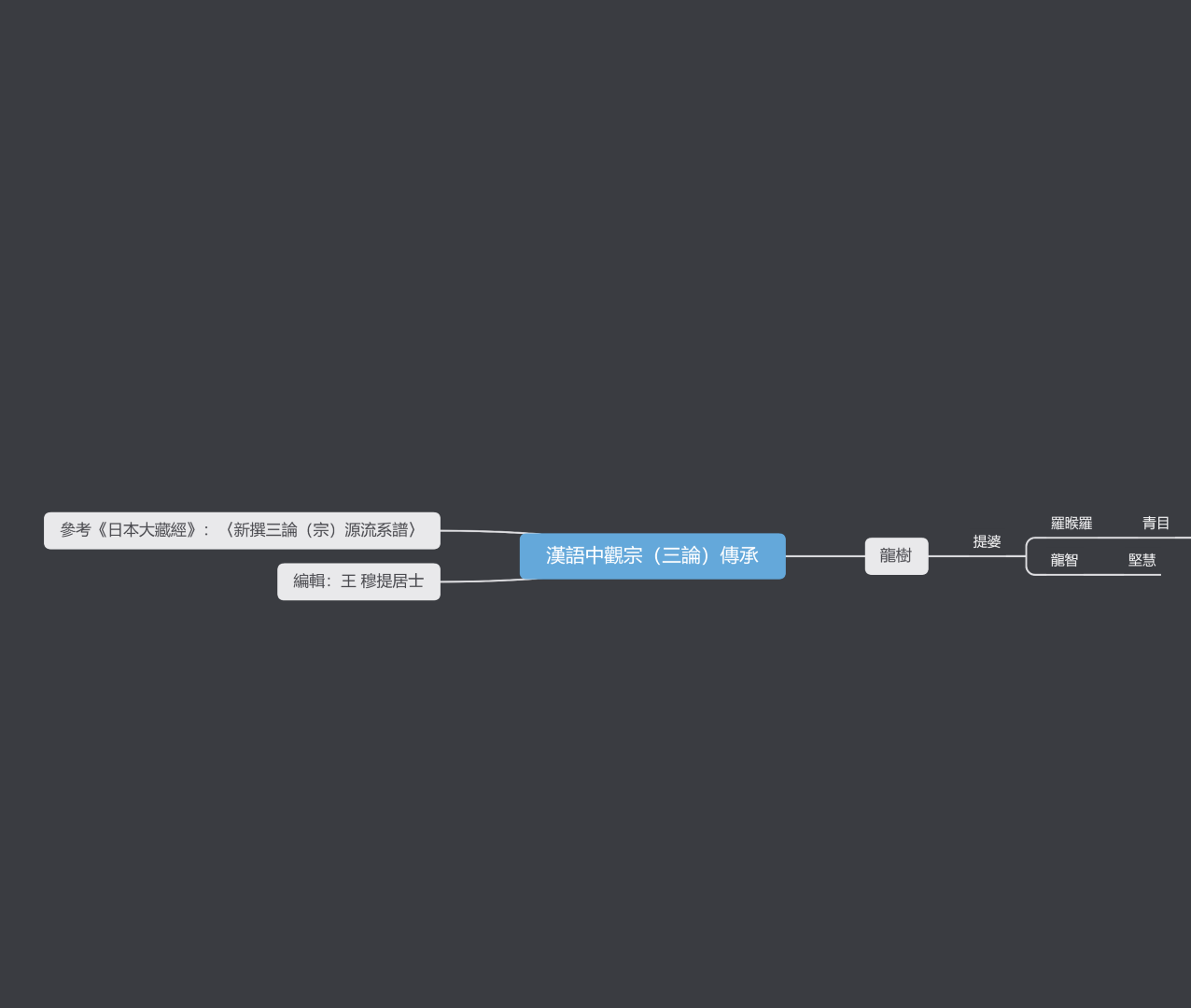
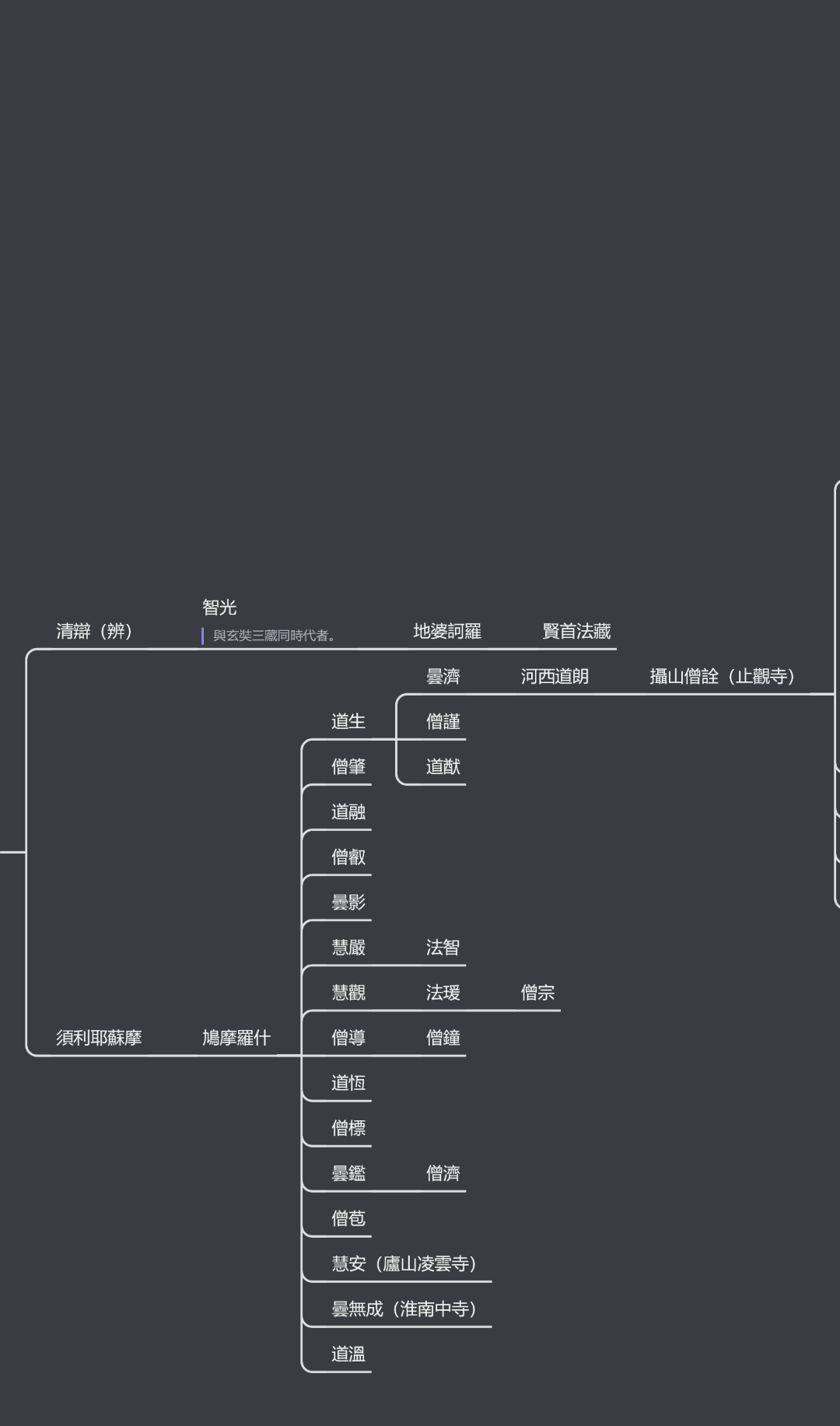
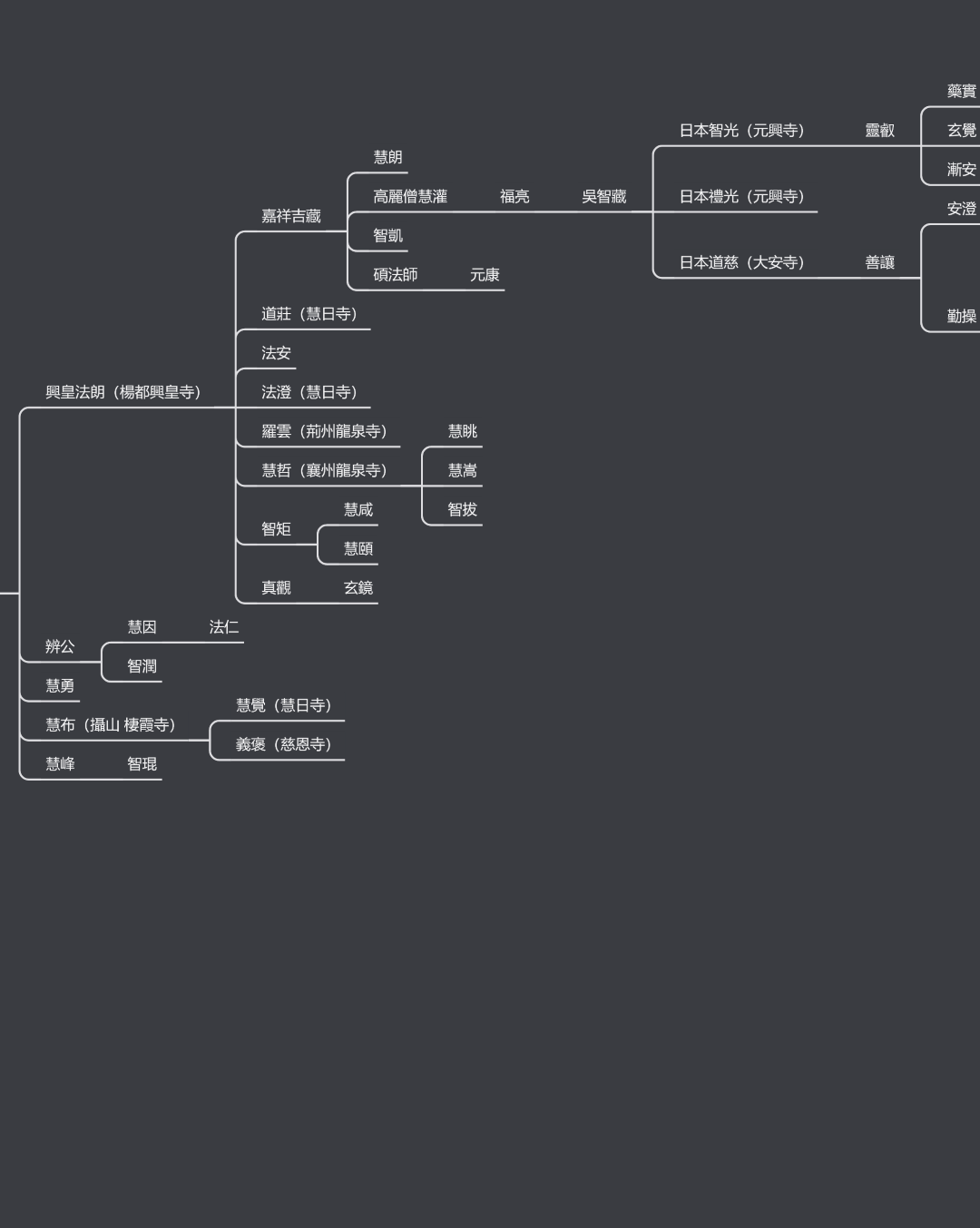
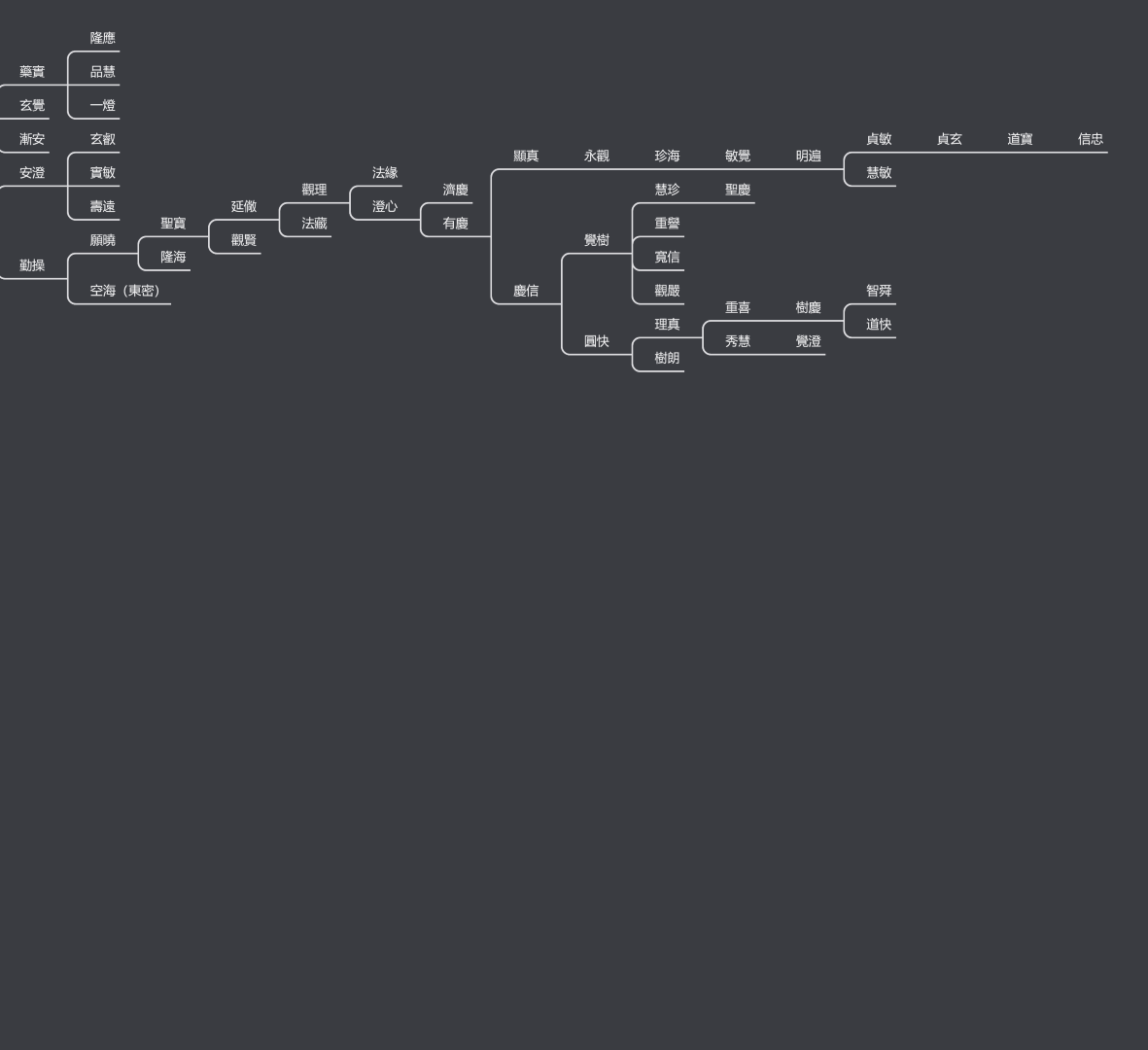
(圖一至四為漢語中觀宗(三論宗)傳承系譜)
另外,關於漢語中觀宗 吉藏大師於世俗勝義諦的論述:
Lineage Genealogy of the Chinese Madhyamaka School (Sanlun School)
Introduction:
As stated in Master Kuiji’s Yilin Zhang regarding the meaning of the word "school" (Zong, 宗): "When speaking of a 'school,' it carries the meanings of reverence, veneration, and paramountcy. That which is revered, venerated, and held as paramount within the holy teachings is therefore called a 'school.' For instance, between heterodox and orthodox paths, or between the Hinayana and Mahayana, what they revere, venerate, and hold as the paramount Dharma differ from one another; hence, they are spoken of as different schools." However, in the Chinese language, the general meaning of "Zong" refers to the fundamental meaning or the main tenet. Although it also carries connotations of an ancestral temple, ancestors, or a faction, the root essence of "Zong" is to take the revered and venerated principles as the foundation for studying the holy teachings.
Nagarjuna transmitted the teachings to Aryadeva. Aryadeva transmitted them to Rahula and Nagabodhi. Rahula transmitted them to Pingala, and Nagabodhi transmitted them to Sthiramati. Pingala transmitted them to Bhaviveka and Suryasoma; Bhaviveka transmitted them to Jnanaprabha, and Suryasoma transmitted them to Kumarajiva. Furthermore, the Japanese monk Gyōnen stated: "Nagarjuna bestowed the teachings upon the Bodhisattvas Nagabodhi and Aryadeva; these two great masters of the wheel jointly propagated the teachings. Nagabodhi bestowed them upon Bodhisattva Bhaviveka, who bestowed them upon Master Jnanaprabha, who in turn bestowed them upon Bodhisattva Simharasmi."
Kumarajiva transmitted the teachings to his ten brilliant disciples: Daosheng, Sengzhao, Daorong, Sengrui, Tanying, Huiyan, Huiguan, Sengdao, Daochang, and Daobiao.
Daosheng, Sengzhao, Daorong, and Sengrui are also known as the "Four Sages of Guanzhong."
Sengrui and Sengzhao are jointly honored as the "Second Patriarchs of the Sanlun (Three Treatises) School." Master Kumarajiva praised Sengzhao, saying: "Among the people of Qin, his understanding of emptiness is unparalleled." Master Sengzhao also attended the translation assemblies of the Kashmiri master Buddhayaśas to listen to the Dīrghāgama and other texts. Moreover, Master Kumarajiva himself had studied under Tripitaka Master Buddhayaśas, who was also known as Mahāvibhāṣā.
Sengzhao transmitted the teachings to Daolang of Hexi; Daolang transmitted them to Sengquan of Mount She; Sengquan transmitted them to Falang of Xinghuang; and Falang transmitted them to Jizang. Jizang transmitted the teachings to Huilang, the Goguryeo monk Hyegwan (Huiguan), Zhikai, and Master Shuo. However, according to the Japanese Sanlun School, Daosheng transmitted them to Tanji, and Tanji transmitted them to Daolang of Hexi.
The Goguryeo monk Hyegwan transmitted the teachings to Fukuryō; Fukuryō transmitted them to Chizō; and Chizō transmitted them to the Japanese monks Chikō (of Gangō-ji), Raikō (of Gangō-ji), and Dōji (of Daian-ji). The Japanese monks Chikō and Raikō transmitted them to Ryōei. Master Shuo transmitted them to Yuankang, and Yuankang transmitted them to the Japanese monk Dōji (of Daian-ji). Dōji also studied Tang Esoteric Buddhism under Tripitaka Master Śubhakarasiṃha. Dōji later transmitted the teachings to Zengi. Afterward, Anchō wrote the Chūron Shoki (Notes on the Commentary of the Middle Way), greatly illuminating Madhyamaka. The Japanese monk Kaikei also authored the Separate Explanations on the Twenty-Seven Chapters of the Madhyamaka Śāstra, the preface of which quotes the Preface to the Madhyamaka Śāstra by Kumarajiva’s disciple, Tanying.
Furthermore, the Japanese monk Gyōnen stated: "Hyegwan bestowed the teachings upon Bishop Fukuryō; Fukuryō bestowed them upon Bishop Chizō; Chizō jointly bestowed them upon Vinaya Master Dōji and Master Raikō. Dōji bestowed them upon the Great Virtuous Zengi; Zengi bestowed them upon Archbishop Gonsō; Gonsō bestowed them upon the Great Virtuous Anchō. Thus, the lineage has been transmitted down to the present without interruption."
Regarding Master Kumarajiva, the middle scroll of the Commentary on the Treatises of Sengzhao states:
"Dharma Master Kumarajiva left the home life at the age of seven. He first studied the various treatises of the Hinayana. By the age of thirteen, he studied under Suryasoma, the son of a state official.</p>
Suryasoma and his brother were two siblings; the elder brother was named Suryabhadra, and the younger was Suryasoma.
Suryasoma's talent and eloquence were unparalleled, and both his elder brother and many others studied under him.
Suryasoma expounded the Anavatapta Sutra for Kumarajiva. When Kumarajiva heard that all dharmas of the aggregates and elements are empty and markless, he was astonished and asked: 'What further meaning does this sutra hold, that it destroys all dharmas?' Suryasoma replied: 'All dharmas, such as the eye, do not truly exist.'
Because Kumarajiva clung to the existence of the sense organs, while Suryasoma argued based on dependent origination that they lack true reality, they debated and scrutinized the Greater and Lesser Vehicles back and forth for a long time. Only then did Kumarajiva realize where the ultimate truth resided. He subsequently devoted himself entirely to the Vaipulya (Mahayana) teachings, extensively seeking the essential meanings and receiving and reciting the Middle Treatise, the Hundred Verses Treatise, and the Twelve Gates Treatise. Hence, it is said that he stepped onto the Great Path at a young age."
This is a brief overview of the lineage of Chinese Madhyamaka. Those who study Chinese Buddhism must not belittle themselves, nor should they harbor arrogance toward others.
Additionally, the Lineage Genealogy of the Sanlun School appended to the Jinling Scriptural Press edition of the Profound Meaning of the Three Treatises (published in 1899/1900, the 25th year of the Guangxu era) corresponds to the Lineage Genealogy of the Sanlun School found in the Nihon Daizōkyō (Japanese Tripitaka, 1914).
Tatsue Nakano (1871–1934), who served as the compiler and publisher for the Manji Daizōkyō, the Manji Zokuzōkyō, and the Nihon Daizōkyō, had previously traveled to Qing dynasty China to collect various Buddhist scriptures. It is highly probable that during that time, he collected the Lineage Genealogy of the Sanlun School appended to the edition of the Profound Meaning of the Three Treatises published by the Jinling Scriptural Press.
Sourced from the Essentials of the Meanings and Texts of the Three Treatises' Profound Meanings and Commentaries by the Japanese Master Chinkai: "From the oral transmission of the bloodline:
Mañjuśrī, Aśvaghoṣa, Nāgārjuna, Āryadeva, Piṅgala, Bhāviveka, Shache, Kumārajīva, Tanying, Sengrui, Daosheng, Sengzhao, Daorong, Daoheng, Huiyan, Huiguan (the above eight luminaries emerged together). Daolang, Sengquan, Faming, Jixiang [Jizang] (the above four masters are in sequence). Yuankang, Xuanshi (the above are Chinese). Vinaya Master Dōji, Great Virtuous Zengi, Archbishop Gonsō, Vinaya Master Gankyō, Archbishop and Reverend Master Shōbō, Bishop Enshin, Acting Senior Bishop Kanri, Bishop Chōshin, Vinaya Master Zaikei, Senior Bishop Yūkei, Kenshin, Vinaya Master Yōkan, Bishop Kakuju, Archbishop Chizō—this lineage can be traced and is recorded separately."
Lineage Genealogy of the Chinese Madhyamaka School (Sanlun School)
(Figures 1 to 4 show the Lineage Genealogy of the Chinese Madhyamaka School / Sanlun School)
Furthermore, regarding the discourse by Master Jizang of the Chinese Madhyamaka School on the Conventional Truth and the Ultimate Truth:
はじめに:
窺基(きき)大師が『大乗法苑義林章』で述べている「宗」の意義は以下の通りです。「そもそも宗を論じるとは、崇(あがめる)、尊(とうとぶ)、主(中心とする)の意義である。聖教において崇められ、尊ばれ、中心とされるものを名付けて宗とするからである。外道と内道(仏教)、小乗と大乗において、崇め、尊び、中心とする法は各々異なっており、これを宗の別と説くのである。」一方、漢語(中国語)で言う「宗」の意味は、大抵の場合「根本の意義」や「主旨」を指し、「祖廟」や「祖先」、あるいは「派別」などの意味もありますが、宗の根本はやはり「崇敬し、尊敬する主旨」を聖教を学ぶ依り所とすることにあります。
龍樹(りゅうじゅ/ナーガールジュナ)は提婆(だいば/アーリヤデーヴァ)に伝え、提婆は羅睺羅(らごら/ラーフラ)と龍智(りゅうち/ナーガボーディ)に伝えました。羅睺羅は青目(しょうもく/ピンガラ)に伝え、龍智は堅慧(けんえ/サーラマティ)に伝えました。青目は清弁(しょうべん/バーヴィヴェーカ)と須利耶蘇摩(しゅりやそま/スーリヤソーマ)に伝え、清弁は智光(ちこう/ジュニャーナプラバ)に伝え、須利耶蘇摩は鳩摩羅什(くまらじゅう/クマーラジーヴァ)に伝えました。また、日本の僧である凝然(ぎょうねん)はこう述べています。「龍樹は龍智菩薩および提婆菩薩に授け、この二大論師は肩を並べて教化を施した。龍智は清弁菩薩に授け、清弁は智光論師に授け、智光は師子光菩薩に授けた。」
鳩摩羅什は、道生(どうしょう)、僧肇(そうじょう)、道融(どうゆう)、僧叡(そうえい)、曇影(どんよう)、慧厳(えごん)、慧観(えかん)、僧導(そうどう)、道常(どうじょう)、道標(どうひょう)の十哲に伝えました。
道生、僧肇、道融、僧叡は「関中四聖(かんちゅうのしせい)」とも呼ばれます。
僧叡と僧肇は共に「三論宗二祖」と称されます。僧肇は羅什公から「秦(しん)の人の中で空を解すること第一の者」と評されました。また肇公(僧肇)は、罽賓(けいひん/カシミール)出身の仏陀耶舎(ぶっだやしゃ/ブッダヤシャス)の訳場において『長阿含経』などを聴聞し、羅什公もまたかつて仏陀耶舎三蔵のもとで教えを受けたことがありました。仏陀耶舎は「大毘婆沙(だいびばしゃ)」とも称されました。
僧肇はこれを河西の道朗(どうろう)に伝え、道朗は摂山の僧詮(そうせん)に伝え、僧詮は興皇の法朗(ほうろう)に伝え、法朗は吉蔵(きつぞう)に伝えました。吉蔵は慧朗(えろう)、高麗僧の慧灌(えかん)、智凱(ちがい)、碩法師(せきほっし)に伝えました。しかし、日本の三論宗の説によれば、道生が曇済(どんさい)に伝え、曇済が河西の道朗に伝えたとされています。
高麗の僧である慧灌は福亮(ふくりょう)に伝え、福亮は智蔵(ちぞう)に伝え、智蔵は日本の智光(ちこう/元興寺)、日本の礼光(らいこう/元興寺)、日本の道慈(どうじ/大安寺)に伝えました。日本の智光(元興寺)と日本の礼光(元興寺)は霊叡(りょうえい)に伝えました。碩法師は元康(げんこう)に伝え、元康は日本の道慈(大安寺)に伝えました。道慈はまた善無畏三蔵(ぜんむいさんぞう)のもとで唐密(唐代の密教)を授かり、道慈は後に善議(ぜんぎ)に伝えました。その後、安澄(あんちょう)が『中論疏記』を著し、中観を大いに顕揚しました。日本の僧である快慶(かいけい)もまた『中観論二十七品別釈』を作り、その序文で羅什公の弟子である曇影の『中論序』を引用しています。
また、日本の僧である凝然師はこう述べています。「慧灌は福亮僧正に授け、福亮は智蔵僧正に授け、智蔵は道慈律師と礼光法師の二人に並び授けた。道慈は善議大徳に授け、善議は勤操(ごんそう)僧正に授け、勤操は安澄大徳に授けた。このように相承して今に至るまで絶えていない。」
羅什公について、『肇論疏(じょうろんしょ)』巻中にはさらにこう記されています。
「什法師(鳩摩羅什)は七歳で出家し、まず小乗の諸論を学び、十三歳に至って、参軍(さんぐん)の王子である須利耶蘇摩のもとで学業を受けた。</p>
蘇摩には兄弟の二人がおり、兄の名を須利耶跋陀(しゅりやばっだ)、弟の名を須利耶蘇摩と言った。
蘇摩は才能と弁舌が群を抜いており、兄や多くの人々が皆彼から学業を受けていた。
蘇摩が羅什のために『阿耨達経(あのくだつきょう)』を説いた際、羅什は五陰(ごおん)や十八界などの諸法が皆「空」であり「無相」であると聞き、怪しんで問うた。「この経には他にどのような意味があって、諸法をすべて破壊(否定)してしまうのか?」蘇摩は答えた。「眼などの諸法は、真実には存在しないのである。」
羅什は(小乗の教えに基づき)感覚器官(根)が実在すると執着していたが、蘇摩は因縁によって成り立つものは実体がない(無実)という根拠に基づいて論じ、かくて大小乗を巡る議論と探求が、時を忘れて往復した。羅什はついに理の帰するところを知り、大乗方等(ほうどう)経典を専ら学び、義理の要旨を広く求め、『中論』、『百論』、『十二門論』などを受け、読誦した。ゆえに「若くして大方(大乗の道)を実践した」と言われるのである。」
以上が、漢語中観(中国の中観派)の伝承の略歴です。漢語仏教を学ぶ者は、自らを軽く見てはならず、また他人に対して慢心を起こしてもなりません。
また、金陵刻経処が光緒二十五年(1900年)に刊行した『三論玄義』の版本に付録されている「三論宗伝承系譜」は、『日本大蔵経』(1914年)の「三論宗伝承系譜」と相当(一致)しています。
中野達慧(1871~1934)は『卍大蔵経』および『卍続蔵経』、『日本大蔵経』の編纂刊行を務めましたが、それ以前に清国(中国)へ赴き各種の仏典を収集していました。おそらくその時に、金陵刻経処が刊行した『三論玄義』の版本に付随する「三論宗伝承系譜」を収集した可能性があると考えられます。
日本の珍海師の『三論玄疏文義要』からの引用:「口伝の血脈より。
文殊、馬鳴、龍樹、提婆、青目、青辨(清弁)、沙車、羅什、曇影、僧叡、道生、僧肇、道融、道恒、惠厳、惠観、(以上八宿は並び出づ。)道朗、僧詮、法明、嘉祥(吉蔵)、(以上四師は次第なり。)元康、玄湜、(以上は漢。)道慈律師、善議大徳、勤操僧正、願暁律師、尊師聖宝僧正、延敒僧都、観理権大僧都、澄心僧都、在慶律師、有慶大僧都、顕眞、永観律師、覚樹僧都、智蔵僧正流をこれ尋ぬべし、別に記す。」
漢語中観宗(三論宗)伝承系譜
(図一から図四は漢語中観宗(三論宗)伝承系譜)
さらに、漢語中観宗の吉蔵大師による世俗・勝義諦に関する論述について: